The world of Handbalancing
An Interview with Antonio Panaro
Hand balancing is a combination of strength, flexibility and good body control. It describes the art of performing balancing acts and movements on one or two hands, and therefore requires years of training.
One person who has mastered this discipline to perfection is the Italian acrobat Antonio Panaro, known as Tony. He and his team were performing the show BELLO! on the Chamäleon stage in spring 2026. In our interview, he offers fascinating insights into his journey from artistic gymnastics to professional circus acrobatics and explains what makes hand balancing so special to him.
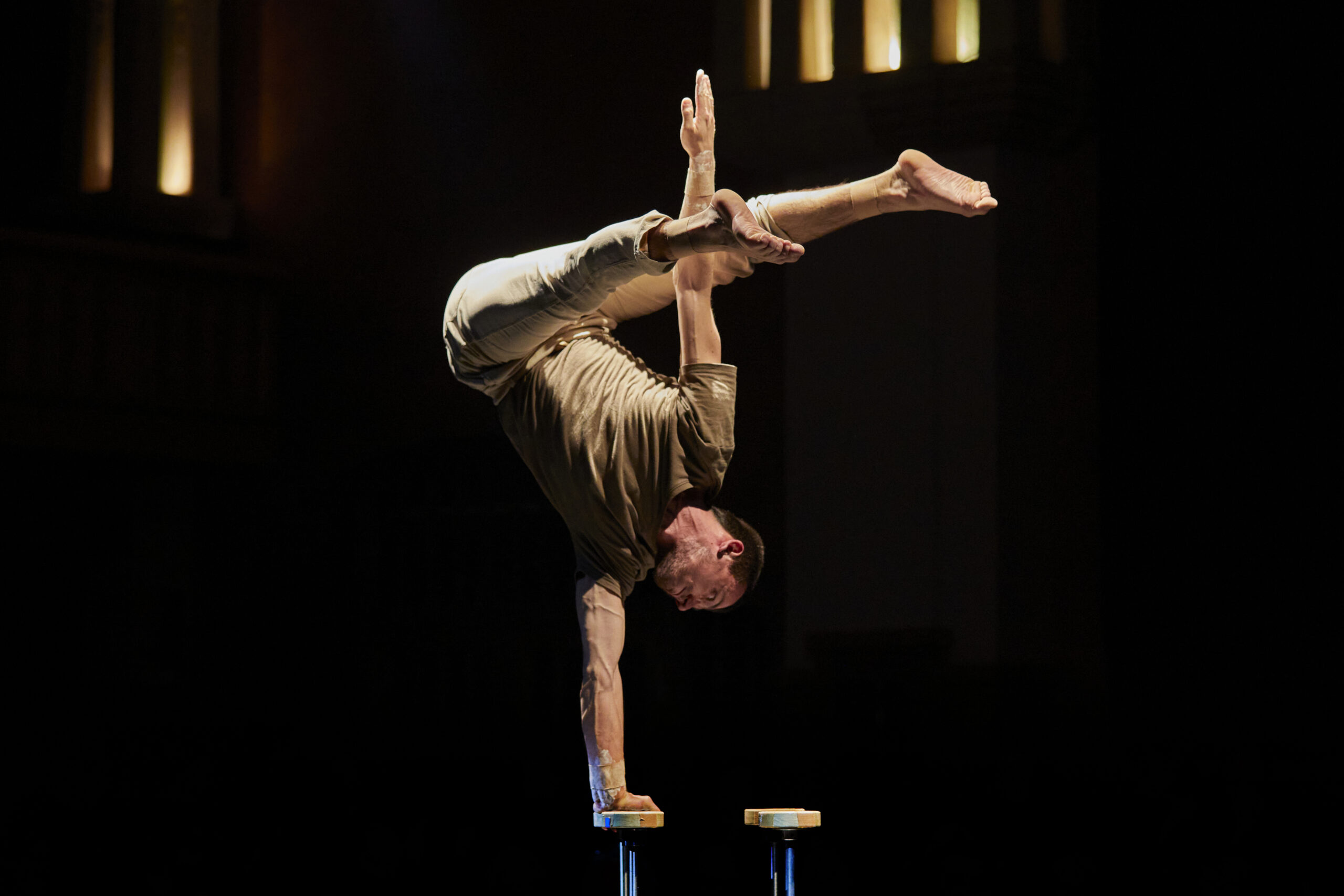 Photo: Andy Phillipson
Hey Tony! Would you say there are certain prerequisites for learning to do a handstand?
I have to be honest and say that you need to be fitter than you think. After all, you’re using your arms as legs, which isn’t exactly natural. If you don’t learn it properly, you can do a lot of things wrong and end up hurting yourself. So my best advice is not to underestimate your own fitness before you start practising the handstand. If you think about it, it’s unrealistic to hold a handstand if you can’t manage 10 push-ups. But if you’re strong and flexible and also have a good sense of balance, those are three very good prerequisites.
Where do you focus your attention when you’re doing a handstand? What do you concentrate on?
The most important thing is exactly where my weight is on my hands. I always try to shift it forwards onto my fingers rather than onto the palms of my hands. The main reason you can’t keep your balance is usually that your weight is on the “heel” of the hands so the lower part of the palms of your hands. Then you have no room to compensate if the rest of your body tilts backwards. Instead, you should shift your weight onto your fingers, as they are much more flexible than the palms. That way, you can maintain your balance better and play around with it more.
When I do a handstand on two arms, my focus is on an imaginary line connecting the centres of my index fingers. When I’m standing on one arm on the floor, it’s basically the same line, but I shift the point over my thumb. When I’m doing a handstand on canes, it’s the platform, so the base where the canes are inserted.
Do you look elsewhere when you’re the flyer, i.e. doing a handstand on someone else’s hands?
I usually look at the floor too, but I know there are different techniques. Some people, for example, look at their partner’s chest or at a specific part of their body. Ultimately, though, it doesn’t really matter, as your partner maintains their balance and keeps you steady.
Even if, ideally, you close your eyes and just stay still – provided you’re a very good flyer – your partner can keep you balanced.
So would you say that doing a handstand on someone else’s hands is easier than on the floor?
In theory, yes. For me, no. For me, it’s really hard to leave my balance in someone else’s hands.
I’ve also noticed that the angle of my wrists is particularly important to me. When doing a handstand, I usually have a very clear sense of the floor, my balance and my posture when my wrist is at a 90-degree angle. When doing a handstand on a base, however, there’s usually no 90-degree angle.
It’s a completely different kind of balance that you have to recalibrate.
Can you think of an unusual place where you’ve done a handstand?
The first thing that springs to mind is a collaboration with the Bello team. We sometimes do site-specific performances. So we go to a location – usually outdoors – and play with the architecture of the place. We put together a 20-minute performance, which we then stage for a few days. Our last site-specific show took place in Turin, Italy.
One unusual place where I did a handstand was during one of those performances. It was on one of two columns that was almost four metres high. You should know that I’m quite afraid of heights. But if I can look at the surface I’m balancing on rather than into the void, that gives me a sense of security. And when you do a handstand at such heights, you don’t use perfect technique. You keep your shoulders a bit closed and not perfectly aligned and opened in a 180° angle so you stay in a safe position. If you do fall, at least you fall safely to your stomach side.
What’s your top tip for beginners?
Push! Push! Push!
You have to push yourself up with your shoulders when doing a handstand. Technically speaking, that’s the most important rule in my opinion.
But it’s also important to enjoy the fitness training. Even the training where you don’t actually do a handstand, but which prepares you for it.
What’s the best feeling for you when you’re doing a handstand?
The best feeling is definitely when you’re doing a handstand on the floor, with your legs close together and your arms raised (rocket or candle position as we call it), and you can feel your body is completely stable. Your elbows are straight and you can feel the weight shifting very quickly to every part of your hands, and only the slightest movements in your hands are enough to balance your whole body. It really is something special.
There was a phrase my teacher at the Circle University in Stockholm used to describe this feeling: ‘Now you can feel the power of the universe in your hands.’